Old Europe, New Europe, Core Europe by Daniel Levy;John C Torpey; & Max Pensky & John Torpey
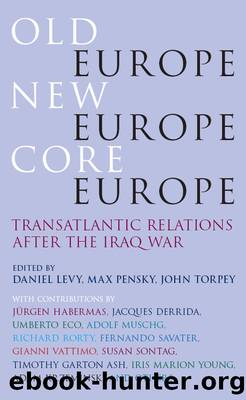
Author:Daniel Levy;John C Torpey; & Max Pensky & John Torpey
Language: eng
Format: epub
Publisher: Lightning Source Inc. (Tier 1)
HABERMAS HAS TOO MUCH
CONFIDENCE IN EUROPE
Joachim Starbatty
Jürgen Habermas doesnât just want to interpret the world; he wants to change it. He has launched an initiative, and Europeâs leading intellectuals have taken up his concept in the leading newspapers of their respective countries. He has proposed that Europe must become a counterbalance to the United States. He wants to instigate discourse all over Europe that will have an impact on public consciousness and, ultimately, on state policy as well. There is a history leading up to his initiative. On April 17, he worked out analytically the causes and consequences of the Iraq war. About two years ago, he presented in Die Zeit the picture of a future Europe.1 His agenda was, appropriately enough for the subject at hand, a mixture of analytical and normative propositions. His call of May 31 is in principle a synthesis of these two texts; thus, the decisive propositions are again normative: âEurope must bring its weight to bear on an international level, and within the scope of the UN, in order to balance the hegemonic unilateralism of the United States.â But the demand that Europe has to do something must be preceded by the diagnosis indicating whether or not a containment of hegemony is even necessary, and whether or not Europe can accomplish it.
In the language of the economists, we can see world peace as a collective good, from whose benefits nobody can be excluded. Yet there will always be rulers or regimes seeking national advantage through the violation of peace. In order to prevent such violations, one needs either a hegemon, which by virtue of its economic and political or military power can push for peaceful behavior and punish disruptive behavior, or a proven system of sanctions to which a group of countries agree. Sanctions are then mutually agreed upon; members can be entrusted with punitive actions. This procedure, too, assumes that there are one or more nations to which the character of a hegemon can be awarded. A group of weak countries would not be capable of making credible threats of sanctions. All participants must defer to common dicta.
Because the United States has released itself from this principle, and instituted the Iraq war without the supporting vote of the UN Security Council, Habermas sees the Councilâs authority in ruins. This view is not shared in the United States; in this newspaper there have been divergent views as well. From an American point of view, it is not the United States that broke international law; it is rather the members of the Security Council, who like to play the role of the anti-hegemon, and would exploit this situation for their own purposes. From this perspective, then, it is the normative authority of the Security Council that lies in ruins. A former American soldier, Ralph Peters, expressed this opinion in this newspaper (Frankfurter Allgemeine Zeitung of May 15) in an unvarnished and provocative manner. As a consequence, he did not initiate a discussion but, instead, set
Download
This site does not store any files on its server. We only index and link to content provided by other sites. Please contact the content providers to delete copyright contents if any and email us, we'll remove relevant links or contents immediately.
Personalized inhaled bacteriophage therapy for treatment of multidrug-resistant Pseudomonas aeruginosa in cystic fibrosis by unknow(215200)
CONSORT 2025 statement: updated guideline for reporting randomized trials by unknow(102522)
Critical evaluation of the ProfiLER-02 study design and outcomes by Vivek Subbiah & Razelle Kurzrock(102050)
Cardiac gene therapy makes a comeback by Oliver J. Müller & Susanne Hille & Anca Kliesow Remes(101839)
Whisky: Malt Whiskies of Scotland (Collins Little Books) by dominic roskrow(74622)
Unveiling the design rules for tunable emission in graphene quantum dots: A high-throughput TDDFT and machine learning perspective by Şener Özönder & Mustafa Coşkun Özdemir & Caner Ünlü(51003)
A yeast-based oral therapeutic delivers immune checkpoint inhibitors to reduce intestinal tumor burden by unknow(40375)
Covalent hitchhikers guide proteins to the nucleus by Alexander F. Russell & Madeline F. Currie & Champak Chatterjee(40297)
Meet the Authors: Christopher R. Mansfield and Emily R. Derbyshire by Christopher R. Mansfield & Emily R. Derbyshire(40210)
Alkaline-earth metals promote propane dehydrogenation with carbon dioxide through geometric effects: Altering the reaction pathway by unknow(32815)
Induced iron vacancies boosting FeOOH loaded on sustainable Fenton-like collagen fiber membrane for efficient removal of emerging contaminants by unknow(32612)
Efficient electric-field-assisted photochemical conversion of methane to n-propanol exclusively over penetrated TiO2Ti hollow fibers by Guanghui Feng(32532)
Bi2SiO5 nanosheets as piezo-photocatalyst for efficient degradation of 2,4-Dichlorophenol by Hangyu Shi & Yifu Li & Lishan Zhang & Guoguan Liu & Qian Zhang & Xuan Ru & Shan Zhong(32470)
A novel NDIPTA organic heterojunction photocatalyst with built-in electric field for efficient hydrogen production by Jiahui Yang & Baojun Ma & Yongfa Zhu(32444)
Enhanced conversion of methane to liquid-phase oxygenates via hollow ferrite nanotube@horseradish peroxidase based photoenzymatic catalysis by Jun Duan & Shiying Fan & Xinyong Li & Shaomin Liu(32406)
Ordered macroporous superstructure of defective carbon adorned with tiny cobalt sulfide for selective electrocatalytic hydrogenation of cinnamaldehyde by Xiao-Shi Yuan & Sheng-Hua Zhou & San-Mei Wang & Wenbo Wei & Xiaofang Li & Xin-Tao Wu & Qi-Long Zhu(32335)
What's Done in Darkness by Kayla Perrin(27262)
Topological analysis of non-conjugated ethylene oxide cored dendrimers decorated with tetraphenylethylene: Insights from degree-based descriptors using the polynomial approach by A Theertha Nair & D Antony Xavier & Annmaria Baby & S Akhila(26632)
Investigation of mechanical and self-healing properties of hydroxyl-terminated polybutadiene functionalized with 2-ureido-4-pyrimidinone by Mohsen Kazazi & Mehran Hayaty & Ali Mousaviazar(26556)
